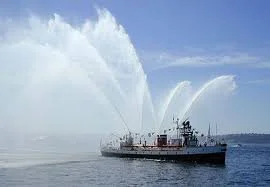
Historic Seattle Fireboat Duwamish
Digitally Preserving a National Historic Landmark
Built in 1909, the Fireboat Duwamish served the Seattle waterfront for more than seven decades and is now preserved as a National Historic Landmark.
Designed to fight fires along Seattle's rapidly developing industrial waterfront, Duwamish represents an important chapter in the maritime, industrial, and firefighting history of the Pacific Northwest.
Today, the vessel is preserved by the Duwamish Fireboat Foundation at the Historic Ships Wharf at Lake Union Park in Seattle.
HAES supports the use of modern documentation technology to help preserve and share historic vessels such as Duwamish with future generations.
3D Laser Scanning the Engine Room
Preserving a Complex Historic Space
Working with Ilios Remote Sensing and Norsk Remote Sensing, the HAES supports the ongoing three-dimensional laser scanning of Duwamish's engine room and later the outside of the ship. Historic ship engine rooms are particularly well suited to 3D documentation. Machinery, piping, valves, structural members, electrical systems, and equipment are densely packed into confined spaces that can be difficult to document completely using conventional photography and measurements.
Terrestrial laser scanning captures millions of measurements throughout the space, creating a detailed three-dimensional record of both the machinery and its spatial relationship to the vessel around it. The resulting point cloud provides a measurable digital record that can support preservation, research, restoration planning, and future comparison. The objective is not simply to create a 3D image. It is to preserve measurable information about the vessel as she exists today.
Preserving Access Through Technology
Documentation, Education & Public Outreach
Digital documentation can also help make historic vessels accessible to people who may never be able to explore them physically. Narrow passageways, steep ladders, machinery spaces, and accessibility limitations can make portions of historic vessels difficult or impossible for many visitors to experience.
Three-dimensional models, point-cloud visualizations, photography, and interactive virtual tours can provide additional ways to explore these spaces while helping museums and preservation organizations explain how historic vessels operated. The digital record can also remain useful as if vessels change through maintenance, restoration, and the passage of time.
By creating a full 3D laser scan of the ship, the HAES hopes that this data will be helpful in acquiring grants for the restoration of the ship, hopefully to one day have all water cannons spraying at the same time.